Showing posts with label conservation. Show all posts

Saturday, January 16, 2016

Paradise in Our Backyard

It warms my heart when I see people interested and actively playing a role in local environmental issues. As is often said, "If it's to be, it's up to me." As a result of this belief, the work of local grassroots organizations often play a pivotal role in driving change and creating awareness. Fortunately for us, we have quite a number of these types of dedicated organizations within our community.

Last night I attended Paradise in Our Backyard, an evening of speakers at St James Anglican Church in Dundas. This event was hosted by the Eco-Churches of West Hamilton which is made up of participating members of 6 area churches, 5 located in Dundas and 1 in West Hamilton. I learned that this group had been formed in 2009 and in that time had been committed to learning and sharing ecological activities and environmental sustainability practices with their respective communities.

With extra chairs needed, last nights talk was greeted by a full house of interested and engaged members of the community eager to listen and learn. Here is just a quick overview:

The first speaker, Alan Hansell of Stewards of Cootes Watershed told a fascinating tale of his groups accomplishments and commitment to get the entire Cootes Watershed area clean and then keep it clean. Some of his stats were hard to fathom, particularly that since 2012, his team of dedicated volunteers have removed 194,827 lbs. of debris from the streams and wetlands that feed this incredibly important area. The Cootes Paradise  watershed supports the ecosystems of at least 9 U.S. states and 5 Canadian provinces as a part of their bird migratory pathways. The efforts that have been taking place here are making a significant difference and the results are measurable based on the growing  populations of various species of birds, fish and animals. Please visit at
www.stewardsofcootes.ca for more information and volunteer opportunities.

Second up was Paul Haskins from the group Burlington Green. He told his personal story of experiencing his home and property being devastated by a flash flood, handling the aftermath  as well as providing tips for managing insurance and mitigating risk. This was a topic that created a lot of interest among the homeowners in the audience as this is a fear that many of us have. Some great information was provided. For more information, please visit them at www.burlingtongreen.org

The final speaker was Leanne Collett who is a Watershed Stewardship Technician with the Hamilton Conservation Authority. Her talk on managing rainwater focused on strategies that both businesses and homeowners can employ to better manage rainwater on their properties. The concept of rain gardens was a fascinating one and I 'm sure something we will hear more of going forward. Many of the strategies shared, from diverting downspouts to utilizing rain barrels are relatively simple to put into practice and these as well as additional ideas can be found by visiting www.hamiltonstewardship.ca

An interesting thought and something we don't often pause to consider is this: All storm sewers are pipes that lead directly into streams and ultimately into the watershed. It is important that we remain vigilant and that each of us act as stewards of our environment.

Lots of questions and dialogue followed the presentations and it was great to witness the high level of interest and engagement.
All of these groups are worthy of our support and our thanks for making the world in which we live, a better place to be. I look forward to learning more about these groups and their activities and sharing them with you.

Sunday, December 27, 2015

Making a Difference in Dundas

If you happened to be entering or leaving Dundas via Cootes Drive this weekend, and if you weren't so consumed with Christmas related activities so as not to notice, then you may have seen Frank and Gisela.

I first noticed them on Saturday, clad in their orange safety vests, a pick-up tool in one hand and a garbage bag in the other. Frank was crossing the grassy median which separates the eastbound from the westbound lanes and Gisela was picking up trash in the culvert that dips down beyond the north shoulder. Of course I didn't know their names yet, but I was immediately impressed by their activity.

Seeing them again today, I felt compelled to stop and speak with them and so found a spot to park and went over to introduce myself. Mainly I just wanted to thank them and let them know that I really appreciated what they were doing.

What a lovely couple. It was a pleasure to meet them and we had a very nice conversation. They let me know that they were volunteers with Stewards of Cootes Watershed and their mission this weekend was to clean up garbage in the wetlands that border this section of road. This is being done in an effort to prevent it from being washed into the waters of the Desjardins Canal and eventually into Cootes Paradise.

Just this weekend alone, Frank and Gisela had cleaned up over 80 pounds of garbage from paper and plastic to discarded diapers and condoms. Gisela let me know that she found it somewhat disheartening that people will still discard their garbage in this way and on this point I'm sure we can all agree.

Stewards of Cootes Watershed is an organization that I know well and one that I will be writing more about in the future. Please visit their website at http://www.stewardsofcootes.ca/ and consider volunteering or supporting them.

This group is certainly making a difference in Dundas and in the Cootes area waterways and they deserve our thanks. If you get a chance, please say thanks to Frank and Gisela as well, a wonderful couple volunteering their time to make Dundas a better place.

Saturday, December 12, 2015

Sawmill Trail Musings


December 12, 2015 arrived like a late fall day, not at all like one would expect just two weeks shy of Christmas. Wearing just a light hoodie, I found myself working up a slight sweat within minutes of navigating the hilly terrain of the Sawmill Trail. The soft ground yielded under the tread of my hiking boots and I noticed that the grass was still holding onto its green colour, determined to not fade into its winter sleep. I can’t recall a December ever being this mild, at least not in the years that I have been exploring the valley. It’s difficult to complain about it although it does seem a little unsettling for it to still be this warm.

Rounding a bend, I stopped abruptly as Stella found herself nose to nose with a young raccoon. Eyeball to eyeball, they stared at each other as I initiated a quick retreat to introduce some space between us. As a rule, I keep Stella on a flexi leash while on the trails, simply due to the frequent encounters with other hikers, mountain bikers and deer, and today I was glad that I had stayed true to that practice.

We are under a rabies alert here at the moment and based on the fact that this raccoon was fearless and not about to move out of our way, I knew that something was clearly not right. We stared at each other and I took this photo before moving on, momentarily leaving the trail to give the raccoon a wide berth as it simply watched our travels. If you are prone to allowing your canine companions off leash while in the valley, I would strongly suggest to you not to do that, particularly during this season. I know that if Stella had been off leash, this encounter would have had a much different and a potentially tragic outcome.
We eventually found our way to the Sawmill Pond, a beautiful oasis in the valley. The Sawmill Pond is a part of the Stacey Meadow, named after former Conservation Authority chairman Alan G. Stacey.

It is a tranquil and quiet spot, ideal for picnics and observing wildlife. This pond, connected to the North Spring Creek, is a source of food, water and shelter for many species and it is common to see Great Blue Herons, Belted Kingfishers and Blackbirds here as well as both painted and snapping turtles. Under the grey sky of today the surrounding cattails and trees created crystal clear reflections of themselves in the still water, and we picked this spot to sit for a minute and just take in the view.

An interesting feature of these ponds is the addition of two small gravel beds. When it was noticed that the resident snapping turtles were laying their eggs in the nearby parking area, these beds were created. This created a safe area protected from vehicle and foot traffic for them, increasing the chances for their eggs to hatch.
Hearing a sound, I looked up to see a pair of deer stepping out from the trees across the pond. They froze when they noted our presence, withdrawing back into the brush. So as to not disturb them, we chose to move on and continued back on the trail, leaving them to their drink.

Turning back, I was amused by the sign on the dock warning of thin ice. Maybe not this year, I thought, at least not for a while.
We headed back down the trail and through a stand of young pine trees, more green on this December day than they should be. This really is a remarkable December, I mused. I can’t wait to get back out here tomorrow.


Do you follow Dundas Valley Outdoors on Twitter? There are lots more photos and trail updates at @DundasOutdoors
Follow us and join the conversation!

Friday, December 4, 2015

A HUGE Thank You!!

It's time for me to give you a huge "thank you"; a sincere, bottom of my heart, humble note of appreciation for letting me communicate with you on this forum and for the unbelievable feedback that you have given me in return, particularly in recent days.

When Dundas Valley Outdoors started in 2011, it was meant as a vehicle for me to share a few stories and some of my photos. I wanted to share my passion for the Dundas Valley with my friends as well as for people who may have been considering a visit to the area. Over the years it has grown and I have made many more friends and contacts as a result and have received tremendous feedback. The blog eventually led to a Facebook page and a Twitter feed, gaining more followers along the way. Eventually the writing and photos grew to the point where a book became a possibility and through the encouragement of many, my book Exploring The Dundas Valley was finished.

Sharing a book launch with 3 friends and fellow writers, our event held in Dundas on November 13 was a huge success and we were overwhelmed with the response. I enjoyed many conversations and opportunities to meet you face to face and I savoured every second of it.

This past Wednesday night was the icing on the cake. When I found out that I had been nominated for a Hamilton Independent Media Award in the category of environmental journalism I was stunned, but to attend this event and actually win was another thing altogether. Totally unexpected, I was blown away and will never forget accepting my "Maggie" in front of a room filled with brilliant local media players. These are the writers, filmmakers and creative geniuses that share their stories and their passion, adding their contribution to the rich arts tapestry that makes Hamilton so special. I had a chance to meet some of the writers that I follow, the ones that I often draw inspiration from and it was great to make so many connections. I've lost track of the messages, texts and phone calls offering a message of congratulations since that evening. Again, just another reason to feel humbled and grateful.


The MC for the evening was Hamilton City Councilor Matthew Green. A rookie councilor, I have been impressed with the energy and level of commitment that he has brought to City Hall. It was great to have a chance to meet and to briefly discuss local issues with him. City leaders such as Matthew Green bring a fresh perspective to our community and to see him supporting this group of passionate advocates for the city and change makers is refreshing and encouraging. We can use more like him, and I feel confident that the positive momentum that we are seeing in many aspects of our community will continue.

This event and award just serve to inspire me further. I am working now to improve this blog and to create a better website to host it. My goal is to develop more content, and to showcase more stories and pictures of the areas that are so important to me and many others. There are conservation and environmental issues that negatively affect and threaten our forests and waterways and I will strive to uncover those and use this medium to help build awareness and drive change. I also have another book in the works, a project I am totally excited about. I look forward to sharing more details on this soon.

So with that, a hearty thank you. I sincerely thank you for your support and your feedback and for those who took the time to vote for me and ultimately allowed me to win the Hamilton Independent Media Award, I am deeply grateful and humbled by your support. I would be remiss if I didn't offer a thank you to the HIMA's team as well, a vibrant and dynamic group working hard to promote local journalism and talent. Their passion is infectious and it was a pleasure to meet Kevin, Sherri, Amanda and others and have the opportunity to learn more about Maggie Hughes as well as their organization.

Again, thank you for your support and loyalty. I promise to work hard and continue to bring you the latest stories and news from the Dundas Valley.

Cam
With fellow award winners Joey Coleman and Hamilton Seen's Cody Lanktree. Photo by Zena Hagerty and used with permission.

Saturday, November 21, 2015

The Hermitage Restoration, One Stone at a Time


One of the most well-known landmarks in the Dundas Valley is the Hermitage. This ruin dates back to before 1855 and has a very interesting history.  According to the historical plaque at the ruins, stones used in construction were quarried from local sites, the red bricks from the Dundas Valley and the limestone sills from the Credit River Valley. The Hermitage had several owners before it was acquired by George Gordon Leith in 1855. 

After George’s death in 1901 his daughter Alma Dick-Lauder bought the estate from the rest of the family and lived there until 1934 when a fire broke out during a party and burned the house down. Even after this fire Alma continued to live on the site, building a modest home within the ruins where she lived until her death in 1942.

A popular destination for hikers visiting the valley, the site had fallen into disrepair over recent years and eventually required structural bracing to the walls and fencing off of the area due to safety concerns. There was even talk of taking down the walls and reducing them to the height of about a metre. It would have been sad to see this structure removed but with the risk of further deterioration, something had to happen.

Fortunately, the Hamilton Conservation Authority along with local government and private donors came up with an ambitious plan to preserve the 160 year old structure.

You should see it now! Reinforced with internal steel supports, the walls are going back up. To keep it as authentic as possible, every single stone was numbered and catalogued to ensure that when rebuilt, it would resemble the original structure as closely as possible.

Fenced off during the construction process, the progress is interesting to see. The stone work around the former main entrance door and windows is beautiful and reconstruction work is continuing up to the second floor. The project is slated for completion in the summer of 2016. If in the area, check it out.

The Hermitage can be found while hiking from the Dundas Valley Trail Centre and is located on the Main Loop. That loop is about 3.5 km and is moderately easy to walk.

Saturday, November 14, 2015

Dundas Eco-Park Update

Have you been by the Dundas Eco-park gateway area lately? This new park which follows the northern shore of the Desjardins Canal is still in its development stage but is coming along nicely.

Those of you who have been watching with interest will recall that this parks sits on the former site of the Ben Veldhuis Greenhouse complex. This large operation once hosted around 20 greenhouses producing more than 3 million cacti a year. This landmark gave Dundas the “Cactus Capital of Canada” moniker and is still remembered annually during Dundas’ always popular Cactus Festival.
The greenhouses are now long gone with the exception of an original two story chimney which is home to a protected at-risk species of chimney swifts. This chimney has become a focal point of the park and has recently been enhanced with an art installation inspired by the former greenhouses. These were provided by the Rotary Clubs of Dundas with a plan to add information panels and benches in the spring of 2016.

Last year, trails were built and hundreds of trees planted. Pilings were also installed in the water to support a future structure. It’s great to see these steps being completed and plantings getting established. With each passing year, this area will become even more inviting.

Additional work is still to come which will include a walkway over the edge of the old canal as well as interpretive displays. Even now, you can see these elements all starting to come together and the overall result so far is excellent.
The Dundas Eco Park Campaign is the Hamilton component of the ambitious Cootes to Escarpment Eco Park campaign, which ultimately will include lands from the waters edge to the Niagara escarpment and will include over 3000 acres in total, a protected and diverse greenspace to be enjoyed for generations.


Guaranteed to become another “must visit” destination in Dundas, we will continue to monitor this exciting project and look forward to seeing it progress.

Tuesday, August 12, 2014

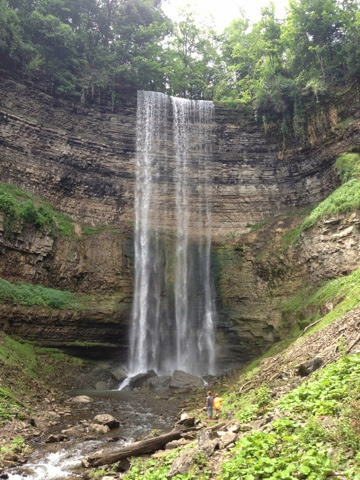
Why The Tews Falls Trail Is My Favorite

As luck would have it, I received 2 different requests to hike the Tews Falls trail in the last couple of weeks, one by my brother and one from an old friend. As this is probably my favorite trail in the entire Dundas trail system, I was happy to oblige to both requests.

In both cases, we started the hike where the railway tracks cross highway 8 in Dundas. Following the rail line until you get to the east side of Spencer Creek, you are treated to a great view of the Dundas  Peak above, another very worthwhile hiking destination.

Entering the forest, the terrain is immediately hilly and the coolness of the valley noticeable. Following the trail keeping the creek to your left and the canyon wall to your right, it is easy to imagine that you are enjoying the same sights as those that were enjoyed by the early settlers to the area.


As the trail starts to descend downward, you soon arrive at Lower Tews Falls. This classic waterfall is an ideal spot to rest and snap a few photos and just fully appreciate the beauty of your surroundings.


This Lower Tews Falls image was captured by my brother Ryan Goede and is one of my favorites.

After a short break, we move on, eventually arriving at Tews Falls. At 130 feet, this is the tallest waterfall in the area and a treat to see from the base. The mist coming off the falls makes this area much cooler and it is a refreshing and cool place to enjoy after the hike in.

Overall, this trail is reminiscent of the kind of natural, untouched and rugged trails that you would find in much more remote regions. From rocky moss covered trails to sky scraping canyon walls to stunning waterfalls, this one has it all. All of those reasons contribute to the fact that this trail has become my favorite in the area.

Count on a good hour and half to two hours to complete this one. It will be time well spent.

Thursday, March 13, 2014

You Can’t Hike the same Trail Twice

There are a few local trails that have over time, become my “go to” destination when I am feeling the urge to get out for a few hours. These are not necessarily the most spectacular of our local destinations but for me there is a sense of familiarity and comfort on these trails that have made them my place to re-charge, my Fortress of Solitude, so to speak.

In spite of visiting often, I am learning that the trail, much like us, is constantly changing, evolving through the changing seasons, growing and dying and never appearing quite the same way twice.

I have also learned that these local and easy to get to destinations can contain
within them those same unique experiences and surprise glimpses of wildlife as what we would expect to see in a far more remote area. The lesson here is that a visit to a trail that is close to home can often be as rewarding as one that takes hours of driving and months of preplanning to get to.

There is room for wonder everywhere as long as you are prepared to open yourself to the opportunity. The changing of the seasons that we experience in our climate play a significant role in this and the sights, sounds and smells on the trail can vary dramatically week to week and based on changes in the weather, even day to day.

I particularly like to explore immediately after a rain or during a light snowfall. I also find that an early morning hike provides a vastly different feast for your senses than one enjoyed at dusk.

Even a familiar trail approached from an unfamiliar direction makes the experience seem fresh and new. 
 
The Greek philosopher Heraclitus said “No man ever steps in the same river twice, for it's not the same river and he's not the same man.”

I believe that this philosophy applies equally to the trail. Because as long as I’ve opened myself to be aware, it’s not the same. To the uninitiated it may appear to be the same trail but it’s still different: different light, different feel, different colors, different sounds, different smells and ultimately a different experience.

I can sense that since my last visit, it has changed, and so have I.

Saturday, March 8, 2014

Winter Hike to Tiffany Falls – Ancaster


When considering a destination for a short winter hike in the area, it’s tough to beat Tiffany Falls. The trail is short and the reward at the end is a view of a waterfall that is amazing to see in any season.


Tiffany Falls is a 21 metre high (70 foot) cascade waterfall and has water flow all year, although at this time of year you only see it in spots. You can still hear it though as it falls behind massive sheets of thick ice.

 
Tiffany Falls Conservation Area is an amazing gem in the area and is considered to be a site of importance from a geographical perspective.  Its bedrock exposures are considered an Earth Science Area of Regional Significance.  The central feature of the conservation area is the two waterfalls within it, Tiffany Falls and Washboard Falls, formed by Tiffany Creek.


Last Saturday, I headed in for a visit accompanied by my daughter Julia and our dog, Stella. Although the trails were icy, we were able to navigate them with reasonable ease and soon were standing at the base of this beautiful waterfall. On this day we were also treated to the site of ice climbers as they bravely scaled the thick ice. 
 

Tiffany Falls is located at the Tiffany Falls Conservation Area in Ancaster.  To get there from Hwy 403 take the Lincoln Alexander Parkway exit and keep to the right to merge onto Rousseau St. At the ‘T’ intersection turn right onto Wilson St. E. Park at Tiffany Falls Conservation Area and follow the trail to the waterfall.

Don’t forget, for more photos and hiking information, you can visit my Facebook page at: https://www.facebook.com/pages/Dundas-Valley-and-beyond/120774278042380

Saturday, April 13, 2013

Discovering the Cheltenham Badlands Trail

I am continually amazed by the rich diversity of southern Ontario. From lush Carolinian forests and rolling meadows to countless waterfalls and lakefront, we seem to have it all. A recent visit to the Cheltenham Badlands in the Caledon area introduced me to a new and very unique landscape unlike anything I had seen before.

Parking at the small makeshift parking lot on Olde Base Line Rd, I stepped out onto the red clay. The colour of the ground immediately catches your eye and provides a sense of the view to be had once you walk the few steps up to the vantage point there. From this point you can see the entire area as it drops away and the uniqueness of the ground is breathtaking.
According to the Ontario Trails Council “Badlands” is a geologic term for an area of soft rock devoid of vegetation and soil cover that has become molded into a rolling landscape of rounded hills and gullies. Such areas are rare in Ontario and this is one of the best examples. They exhibit the reddish hue of the Queenston Shale that forms them; the iron oxide in the shale produces this colour. The narrow greenish bands that can be seen throughout the shale are due to the change of red iron oxide to green iron oxide brought on by the circulating groundwater. The relatively soft shale is essentially clay and is easily eroded by water. This site was acquired by the Ontario Heritage Foundation in 2000 and is under the care of the Bruce Trail Association.


As this is a sensitive natural area, walking through it is discouraged. The Bruce Trail travels just past this site and it is just a short walk off the main trail to the access point.
This such an interesting area and I look forward to the opportunity of a summer return. I imagine that when the surrounding woodlands are fully green the contrast will be spectacular. Catching a sunrise or sunset from this area would also be very worthwhile.

Sunday, February 17, 2013

The Beach in January

With a warm snap bringing the temperature to around 15 degree’s C, the melting snow turned the valley trails temporarily muddy and impassable. It seemed to me that this would be a great day to check out Hamilton’s Beach Trail.

Living so close to it, it is sometimes easy to forget that the 14th largest freshwater lake in the world is just minutes away. The Hamilton Beach Trail which is a part of the larger Waterfront trail system is a multi-use paved surface and is an ideal place to walk when the ground is soft and muddy.

On this day I parked at the lot by Hutches Restaurant and walked east in the direction of Confederation Park. Meeting plenty of runners, dog walkers and cyclists, all of whom said hello in passing, I enjoyed the lake views that this trail provides. Rosie enjoyed running on the beach and playing in the incoming surf.

It was a rare treat to be able to enjoy the beach and comfortable temperatures in the middle of January and I look forward to returning in the spring and summer.

Just a reminder that more photos and trail information are always available on my Facebook page at: https://www.facebook.com/pages/Dundas-Valley-and-beyond/120774278042380

Get out and enjoy this amazing weather!!

Saturday, December 29, 2012

Goodbye 2012

I have to admit, I am a big fan of the changing seasons in Ontario. I love the newness of spring, the deep greens and wildlife activity of the summer, the intense colours of fall and the silence and clean landscapes of winter.
This is also the time of year that I build my plan and goals for the new year and take time to reflect on the year gone by.
Waking this morning to a fresh covering of snow, I took full advantage of the opportunity to explore the Spring Creek Trail and take the time to think back with gratitude on the many hiking and camping opportunities that I had in 2012.
There is something about a fresh covering of snow that helps to clear your head and cleanse your mind and I returned from this hike feeling truly refreshed.
It was just over a year ago that I started this blog and in that time I have explored many of the trails of the Dundas Valley. I have had the opportunity to share thoughts with readers and meet some terrific people who share my passion for hiking and photography. It has been a lot of fun and I have learned a lot.
I am looking forward to much more exploring in this area in 2013 and sharing more photos and hiking ideas with you.
A sincere thank you for the many comments and words of encouragement this year. They are greatly appreciated.

Also, thank you for the many of you that have visited and left comments on my Facebook page at: https://www.facebook.com/pages/Dundas-Valley-and-beyond/120774278042380

Please accept my wishes to you for a healthy and happy 2013 and one that is filled with amazing outdoor experiences.

Cam

Saturday, December 1, 2012

First Snowfall of the Year

The first snowfall of the year means for me a chance to get out and explore while everything is covered in a blanket of white.

Looking out the window on the morning of December 1, a beautiful scene presented itself with the trees and the yard covered in an inch or so of fresh white snow. With coffee in hand, Rosie and I headed to Cascades Park which is located on Livingstone Drive in Dundas and started hiking up the Bruce Trail side trail that heads to Upper Sydenham Falls.

Although the water level was low, icicles had formed on the face of this 45 foot ribbon type waterfall. It was hard to imagine that just 24 hours before there would have been none to see.

The winter season is just beginning and I am looking forward to exploring as many of the trails and waterfalls as I can.

Don’t forget, for more photos and hiking information, you can visit my Facebook page at: https://www.facebook.com/pages/Dundas-Valley-and-beyond/120774278042380

Thanks for visiting!!

Saturday, November 24, 2012

Christie Wildlife Area

The morning fog was just starting to lift as Rosie and I headed down the trail at the Christie Wildlife area. I had found this spot completely by accident, driving north on Middletown Road just north of Regional Road 8. Fortunately, I had spotted the small parking lot on the left side of the road and now as luck would have it, we were exploring a new trail.

This beautiful marsh area feeds into Christie Lake and features a relatively short and mostly flat perimeter trail that follows the shoreline of the marsh. I can imagine that this area is teeming with wildlife during the spring and summer months but with it now being mid November it was quiet with the exception of some song birds and a few groups of ducks, mostly mallards occupying the water.

Exploring the trails, we walked through stands of cedar and pine transitioning into maple and other deciduous trees on the western shoreline. The trail was mostly grass covered and well marked and features a bridge where the trail begins the returning portion.

You can see by my GPS that I made one small error requiring me to backtrack when I realized I was off course but other than that the walk was enjoyable and quiet.

Returning, I made a mental note to definitely plan on a returning as I would love to see the landscape during the winter, spring and summer seasons as well.

Don’t forget, for more photos and hiking information, you can visit my Facebook page at: https://www.facebook.com/pages/Dundas-Valley-and-beyond/120774278042380

Thanks for visiting!!