Tuesday, August 12, 2014

Why The Tews Falls Trail Is My Favorite

As luck would have it, I received 2 different requests to hike the Tews Falls trail in the last couple of weeks, one by my brother and one from an old friend. As this is probably my favorite trail in the entire Dundas trail system, I was happy to oblige to both requests.

In both cases, we started the hike where the railway tracks cross highway 8 in Dundas. Following the rail line until you get to the east side of Spencer Creek, you are treated to a great view of the Dundas  Peak above, another very worthwhile hiking destination.

Entering the forest, the terrain is immediately hilly and the coolness of the valley noticeable. Following the trail keeping the creek to your left and the canyon wall to your right, it is easy to imagine that you are enjoying the same sights as those that were enjoyed by the early settlers to the area.


As the trail starts to descend downward, you soon arrive at Lower Tews Falls. This classic waterfall is an ideal spot to rest and snap a few photos and just fully appreciate the beauty of your surroundings.


This Lower Tews Falls image was captured by my brother Ryan Goede and is one of my favorites.

After a short break, we move on, eventually arriving at Tews Falls. At 130 feet, this is the tallest waterfall in the area and a treat to see from the base. The mist coming off the falls makes this area much cooler and it is a refreshing and cool place to enjoy after the hike in.
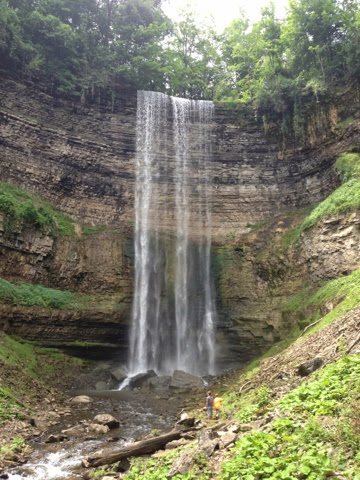
Overall, this trail is reminiscent of the kind of natural, untouched and rugged trails that you would find in much more remote regions. From rocky moss covered trails to sky scraping canyon walls to stunning waterfalls, this one has it all. All of those reasons contribute to the fact that this trail has become my favorite in the area.

Count on a good hour and half to two hours to complete this one. It will be time well spent.

Monday, August 11, 2014

Change, It's Always Good

Over the past few weeks, I've had the opportunity to get out and hike and paddle in some great areas from Lake Erie to Letchworth State Park in New York to my personal favorite mental rejuvenation location; Algonquin Park. On top of the obvious benefit of being immersed in absolutely breathtaking surroundings, these trips also provide ample time for thought and quiet reflection.


Part of my time away I devoted to reflecting on this blog; what works, what I'd like to change and strategizing on how I can shake it up and freshen it up a little. Like the seasons, change keeps things interesting and hopefully a few tweaks will make it a better resource for you as well.

A couple changes to note:

1. A new name. Dundas Valley Outdoors for me is a better reflection of what I'd like to focus on. As kayaking and cycling trips are added into the mix, the common element remains a focus on enjoying the outdoors in this area, regardless of activity.

2. A new look. A green background will represent a focus on our precious environment and my commitment to sustainability and conservation.

3. A new Twitter feed. @DundasOutdoors will feature photos and trail updates as well as related news. I hope to add this feed directly into this blog in the near future.

There are a few more changes in the works so stay tuned. Your suggestions are always welcome and as always, I graciously thank you for your support.

Saturday, June 21, 2014

Paradise in the City

We have some pretty amazing gems right here in our own backyard. From spectacular waterfalls to breathtaking trails, the natural areas around Dundas and Hamilton have lots to offer.

An area that I am just beginning to discover is Cootes Paradise. 


Cootes Paradise is the largest wetland at the western end of Lake Ontario and is on the west side of Hamilton Harbour.  It is owned and managed by the Royal Botanical Gardens and is a National Historic site, a Nationally Important Bird Area (IBA), and a Nationally Important Reptile and Amphibian Area (IMPARA).

Rising early this morning, I launched my kayak at Princess Point and headed around the point, then west going behind Cockpit Island and Sassafras Point and exploring the various inlets along the way. The silence was often interrupted by jumping fish and the swans, ducks and geese were plentiful. 

On a couple of occasions I was treated to the sight of large blue herons perched in the trees or lazily flying overhead, their massive wingspan reminding me of schoolbook illustrations of ancient pterodactyls.

Crossing over towards Bulls Point I was able to watch numerous waterfowl including some low flying trumpeter swans and a couple of mergansers that did low flyby's for my benefit, just skimming the water as they passed.

On prior occasions I have seen the pair of bald eagles that nest along the northern shore but unfortunately not this morning.

I enjoyed the site of the water plants and the shoreline, impressed that this level of nature and plentiful wildlife can be found so close to a major city.

I crossed back over heading back towards Princess Point. This area of the bay is one where I often like to pause when kayaking to enjoy the sunset and reflect.


On this morning I simply pushed through, heading back to the dock and making myself the promise to return again soon to this little bit of paradise in the city.


Thursday, March 13, 2014

You Can’t Hike the same Trail Twice

There are a few local trails that have over time, become my “go to” destination when I am feeling the urge to get out for a few hours. These are not necessarily the most spectacular of our local destinations but for me there is a sense of familiarity and comfort on these trails that have made them my place to re-charge, my Fortress of Solitude, so to speak.

In spite of visiting often, I am learning that the trail, much like us, is constantly changing, evolving through the changing seasons, growing and dying and never appearing quite the same way twice.

I have also learned that these local and easy to get to destinations can contain
within them those same unique experiences and surprise glimpses of wildlife as what we would expect to see in a far more remote area. The lesson here is that a visit to a trail that is close to home can often be as rewarding as one that takes hours of driving and months of preplanning to get to.

There is room for wonder everywhere as long as you are prepared to open yourself to the opportunity. The changing of the seasons that we experience in our climate play a significant role in this and the sights, sounds and smells on the trail can vary dramatically week to week and based on changes in the weather, even day to day.

I particularly like to explore immediately after a rain or during a light snowfall. I also find that an early morning hike provides a vastly different feast for your senses than one enjoyed at dusk.

Even a familiar trail approached from an unfamiliar direction makes the experience seem fresh and new. 
 
The Greek philosopher Heraclitus said “No man ever steps in the same river twice, for it's not the same river and he's not the same man.”

I believe that this philosophy applies equally to the trail. Because as long as I’ve opened myself to be aware, it’s not the same. To the uninitiated it may appear to be the same trail but it’s still different: different light, different feel, different colors, different sounds, different smells and ultimately a different experience.

I can sense that since my last visit, it has changed, and so have I.

Saturday, March 8, 2014

Winter Hike to Tiffany Falls – Ancaster


When considering a destination for a short winter hike in the area, it’s tough to beat Tiffany Falls. The trail is short and the reward at the end is a view of a waterfall that is amazing to see in any season.


Tiffany Falls is a 21 metre high (70 foot) cascade waterfall and has water flow all year, although at this time of year you only see it in spots. You can still hear it though as it falls behind massive sheets of thick ice.

 
Tiffany Falls Conservation Area is an amazing gem in the area and is considered to be a site of importance from a geographical perspective.  Its bedrock exposures are considered an Earth Science Area of Regional Significance.  The central feature of the conservation area is the two waterfalls within it, Tiffany Falls and Washboard Falls, formed by Tiffany Creek.


Last Saturday, I headed in for a visit accompanied by my daughter Julia and our dog, Stella. Although the trails were icy, we were able to navigate them with reasonable ease and soon were standing at the base of this beautiful waterfall. On this day we were also treated to the site of ice climbers as they bravely scaled the thick ice. 
 

Tiffany Falls is located at the Tiffany Falls Conservation Area in Ancaster.  To get there from Hwy 403 take the Lincoln Alexander Parkway exit and keep to the right to merge onto Rousseau St. At the ‘T’ intersection turn right onto Wilson St. E. Park at Tiffany Falls Conservation Area and follow the trail to the waterfall.

Don’t forget, for more photos and hiking information, you can visit my Facebook page at: https://www.facebook.com/pages/Dundas-Valley-and-beyond/120774278042380

Friday, February 28, 2014

5 Reasons to get out Hiking this Winter

This winter feels like its been extraordinarily long and cold but even with that there have been many days when getting out and exploring a trail have been not only possible but very worthwhile.

Besides the obvious advantage of no bugs, here are 5 benefits to getting out hiking in the winter:


Fresh Perspective.

Even trails that you frequently explore look different under a fresh layer of snow. Streams and trees look different and waterfalls take on a whole new and spectacular look.


Less People

If peace and solitude are an important component of your hiking experience, then winter is the ideal time to get outside.

More Wildlife

The combination of less people on the trails and significantly less leaf cover mean you can see further distances. The obvious benefit is that you can spot more wildlife. Deer are easy to find in the valley and woodpeckers and other birds are plentiful. Bring some seed along and some of those friendly birds are likely to get very close in exchange for a snack.


More Exercise

Added winter clothing and snow covered trails add resistance to your movement and with that comes additional health benefits.  You can improve your strength and cardiovascular health while at the same time relieving stress and eliminating the winter blues. Hiking is proven to aid in weight loss and helps to protect against heart disease, diabetes and depression. The extra work involved in hiking in the winter burns more calories and provides you with fitness benefits sooner.
Plus staying active and and fit during the winter months ensures that you'll be in top shape when the regular season begins.


Improved Mental health

It's been said that it is impossible to be in a bad mood and be in the woods at the same time and I can certainly attest to that. Try walking a trail on a sunny winter day with a light snow falling and you instantly feel the happy effects of endorphins combined with fresh crisp air. Scientific studies have long supported the benefits of nature and hiking on mental health and there is no doubt that it is an effective stress reliever and a great way to clear your mind.
 

So take advantage this winter. Bundle up and explore, I promise that you will be glad you did.

Just a reminder that more photos and trail information are always available on my Facebook page at: https://www.facebook.com/pages/Dundas-Valley-and-beyond/120774278042380